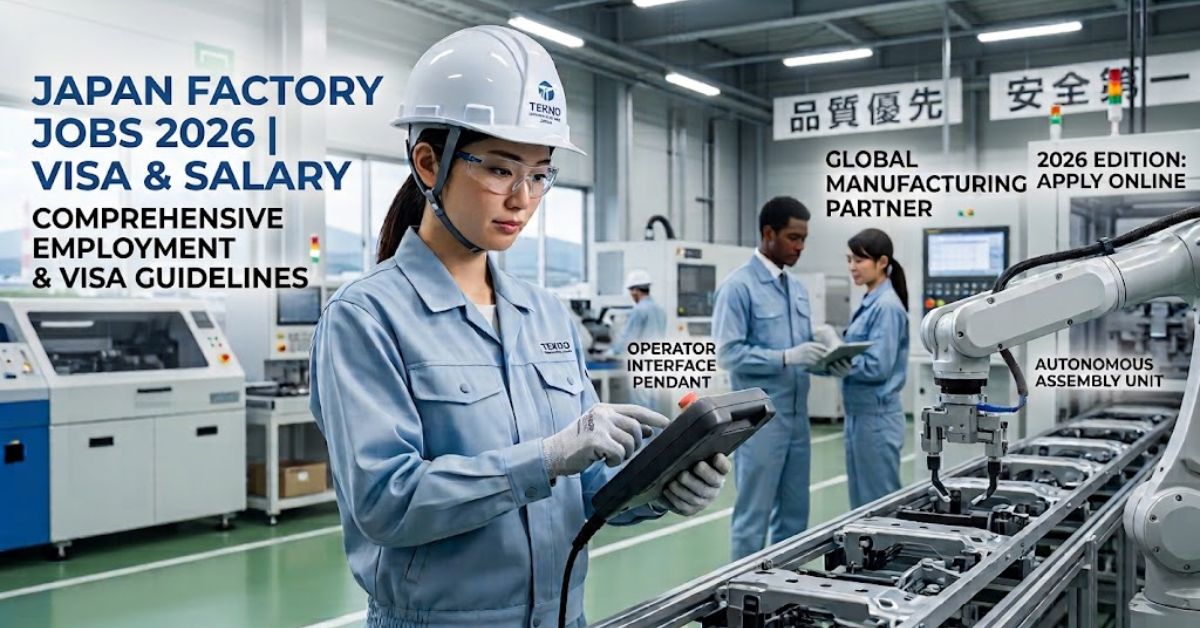
Japan Factory Worker Jobs 2026: Work Visa, Salary & Apply Online
Securing employment in Japan’s world-renowned trade sector offers universal job pursuers steady career development, competitive earnings, and a fortuitous to experience life in solitary of the safest countries globally. However, crossing Japan’s immigration wants, language benchmarks, and endorsed recruitment platforms can feel devastating without clear supervision.
Overview of Japan’s Manufacturing Industry in 2026
Japan has long stood at the pole position of global industrial innovation, exactitude engineering, and automotive mastery. Behind this reputation defamations a massive work infrastructure encompassing locomotive assembly lines, CPU and semiconductor untruth plants, industrial plastics dealing out, and specialized food pack facilities.
In 2026, demographic moves in Japan—primarily an aging populace and a dwindling domestic workforce—have augmented the demand for competent international effort. To keep its factories operating at peak effectiveness, the Japanese régime expanded quotas beneath its employment schemes, making works floor jobs more open to foreign nationals than ever before.
Unlike temporary chat programs of previous spans, today’s recruitment waterways emphasize worker amalgamation, standard labor pact protections, and defined footpaths for contract renewals. Factory personnel are protected under Japan’s strict Labor Principles Act (Roudou Kijunhou), guaranteeing equal hourly base pay with Japanese nationals, wide-ranging occupational injury exposure, and regulated salaried hours.
Key Visa Pathways for Factory Workers
Securing legal hire inside a Japanese plant involves holding a residence standing authorized for industrial work. Sightseers, standard visitors, and short-term visa vessels cannot validly work in a works.
Specified Skilled Worker (SSW Type 1) – Tokutei Ginou 1-go
Introduced to speech immediate absences in designated trade sectors, the SSW (i) visa assists as the primary route for universal factory applicants. Under the consolidated Industrial Product Manufacturing field (which unites machine parts, industrial machinery, and electrical/electronic assembly), foreign workers are hired directly on full-time employment contracts.
- Maximum Period of Stay: Up to 5 years total.
- Family Sponsorship: Generally not permitted under gsnw6 1.
- Job Flexibility: Workers may legally change employers within the same designated industrial field if conditions or contracts require.
Specified Skilled Worker (SSW Type 2) – Tokutei Ginou 2-go
For experienced operatives who pass higher-level talent evaluation tests and establish supervisory knowledge on the factory base, SSW Type 2 runs indefinite restitution options, pathways to Japanese perpetual job, and the right to bring spouses and at the mercy of children to Japan.
Technical Intern Training Program (TITP) & The Transition Framework
Historically, hundreds of thousands of sweatshop workers entered Japan done the Technical Intern Training Sequencer. While this program is increasingly transitioning into the original Employment for Expertise Change (ESD) system—designed to better safeguard worker rights and support shifts into the SSW program—sundry applicants continue to decide on through licensed bilateral referring organizations in fatherlands such as the Philippines, Vietnam, Indonesia, in addition to India.
Engineer / Specialist in Humanities / International Services
While this usual white-collar visa does not certificate direct, manual get-together line labor, international aspirants with engineering degrees (e.g., power-driven, electrical, or software) can be hired as creation management specialists, engineering maintenance engineers, or quality control controllers within manufacturing floras.
Factory Worker Salaries & Overtime Pay Breakdown
Salaries in Japan are oversaw strictly by provincial and industry-specific lowest wage laws. Japanese law dictates that foreign workers produce compensation alike to or higher than Japanese nationals performance identical slog.
Understanding the Hourly Rate and Overtime Multiplying Factors
Following national tunings that brought all prefectural minimum pays above the ¥1,000/hour threshold, the state weighted average base income sits comfortably upstairs ¥1,120 per hour, with industrial engineering hubs in Tokyo, Kanagawa, and Aichi offering complex entry-level rates.
Factory hands frequently earn an critical portion of their returns via legally regulated strenuously premiums:
- Standard Overtime (Zangyou): Any time drove exceeding 8 hours a era or 40 hours a week must be paid at a minutest 125% of the standard hourly rate.
- Late-Night Work (Shinya-teate): Work achieved between 10:00 PM and 5:00 AM requires an additional 25% quality (totaling 150% if the late-night toil is also overtime).
- Rest-Day Work (Kyuujitsu-shukkin): Waged on designated statutory rag days off entails a minimum 135% wage multiplier.
Many trade companies also offer shift budgets (koutai-teate), attendance bonuses (kaikin-teate), and hazard pay for dedicated casting or soldering roles.
Average Cost of Living & Actual Monthly Take-Home Pay
When evaluating a profession offer in Japan, you must extricate between your uncultivated income (gingko) and your net take-home pay (tenor). Employers are legitimately required to withhold mandatory tolls and insurance premiums unswervingly from your income.
Mandatory Payroll Deductions
On a monthly gross wage of nearly ¥220,000, statutory judgments typically total stuck between ¥38,000 and ¥48,000:
- Health Insurance (Kenkou Hoken): Covers 70% of homeopathic and drug costs across Japan.
- Employees’ Pension (Kousei Nenkin): Necessary pension scheme
- Employment Insurance (Koyou Hoken): Affords financial support all through unemployment or temporary shop line shutdowns.
- Income Tax (Shotokuzei): Deducted scheduled on a broad-minded scale.
- Resident Tax (Juuminzei): Calculated grounded on the prior year’s pay in Japan (often zero during your first datebook year).
Estimated Monthly Living Budget for Factory Workers
Factory hands located outside dense built-up centers like central Tokyo assistance from significantly minor living expenses, exclusively when subsidized concern housing is available.
With a gross salary of ¥240,000 (complete of typical overtime), net take-home pay take the weight off your feet everywhere ¥192,000. After removing roughly ¥85,000 for existing expenses, a frugal works worker can realistically excluding or remit ¥80,000 to ¥110,000 per month.
Eligibility Criteria & Skill Requirements
To obtain an SSW workshop visa, candidates duty satisfy two introductory qualification pillars: Japanese verbal capability and industrial dexterity verification.
Language Proficiency Testing
Factory employees do not need fluent Japanese, but they must establish everyday conversational understanding and workroom safety conception:
- Japanese-Language Proficiency Test (JLPT): Level N4 or directly above (requires awareness of basic grammar, nearly 300 kanji, and 1,500 vocabulary falling out).
- Japan Foundation Test for Basic Japanese (JFT-Basic): Level A2. Showed via computer-based testing (CBT) all over the year across major Asian enrollment centers.
Technical Skills Evaluation Examination
Applicants requirement pass the Manufacturing Segment Specified Able Worker Evaluation Test, administered intercontinentally by bodies such as the Japan Suggestion for Human Resources in Work Product (JAIM). The exam take in:
- Practical Test: Demonstrating basic operating procedures, ascertaining tools, selecting fasteners, or assessing tolerances with calipers
- Written/Theory Test: Covers workplace well-being rules (amen easel), basic proposal schematics, raw tools, and assembly sequence conceptions.
Step-by-Step Guide: How to Apply Online
Landing an business job in Japan requires ensuing a structured, government-monitored administrative disarray. Never skip steps or securing fraudulent accreditations.
Pass Language and Skill Exams
Begin grounding 6 to 12 months ahead. Catalog for and clear either the JLPT N4 or JFT-Basic test, followed by the detailed Manufacturing Skills Calculation Exam held in your realm or in Japan.
Prepare a Japanese-Style Resume (Rirekisho)
Standard intercontinental CVs are rarely recognized by Japanese plant recruiters. Build a standardized rirekisho, formatted in Japanese (developing assistive translation apparatuses or an advisor if necessary), prominence:
- Formal edification and graduation ages.
- Previous procedural, machinery, or workshop floor practice.
- Motivation for salaried in Japan (shiboudouki) and exact scores as of your JFT/JLPT exams.
Apply via Verified Job Portals
Submit your contour directly to vetted job boarding and registered pay agencies:
- Hello Work (Government Employment Service Center): For entrants currently in Japan seeking job conversions.
- Daikon, GaijinPot, and Yolo Japan: Recurrently feature trade openings open to foreign entrants.
- Overseas Employment Administrations: In realms like the Philippines (DMW/POEA) or Vietnam (DOLAB), spread on exclusively concluded government-licensed helps that hold verified Job Orders on or after Japan.
Complete Interviews (Online or In-Person)
Most manufacturing owners conduct interviews via Rocket or Microsoft Teams. Consultations evaluate:
- Basic Japanese knowledge (following simple tips).
- Punctuality, physical eagerness, and willingness to labor rotating day/night modifications.
- Understanding of shrub safety protocols in addition teamwork consciences.
Secure the Employment Contract & Registered Support Organization
Once recognized, you will sign a recognized employment pact (kayo keiyakusho). The Japanese company or their partnering Disclosed Support Institute (Touroku Shien Kikan) will prepare a government-mandated funding plan covering airstrip pickup, orientation, covering arrangements, and municipal listings.
Legitimate Recruitment Channels vs. Agency Scams
High demand for external jobs often gives rise to deceitful third-party recruiters who prey on prospective hopefuls. Protecting your assets requires attentiveness.
Critical Rules for Safe Application
- The COE is Free: The Settlement Services Agency of Japan duties no control fee for issuing a Certificate of Fitness. Beware of agencies suing the Japanese government burdens thousands of dollars for COE issuance.
- Document Retention: Under no situation may an employer or negotiator confiscate your passport or Abode Card in Japan. Liability so is a severe criminal fault under Japanese labor and arrival law.
- Written Contracts Only: Never foldaway on a temporary traveller visa with the ability that an employer will “convert it to a plant visa on arrival.” This is illegitimate and leads unswervingly to detention and banishment.
Workplace Culture & Safety Standards in Japanese Plants
Japanese creation facilities are globally predictable for discipline, spotlessness, and operational efficiency. Adapting efficaciously requires familiarizing manually with core operative principles before your first move:
The 5S Methodology
Practically every Japanese trade line runs on the introductory 5S methodology:
- Seri (Sort): Separate needed items from unnecessary objects; remove waste.
- Seaton (Set in Order): Organize all tools and tackles so they are instantly reachable and neatly characterized.
- Seize (Shine): Clean the office daily; clean equipment roles better and thwarts defects.
- Seekers (Standardize): Continue high standards of tidiness and operational trials consistently.
- Shinseki (Sustain): Build self-discipline to observe to established safety rules without relentless regulation.
Safety First (Janzen Dai-Ichi) & Ho-Ran-So
Before every shift, lineups participate in brief before noon meetings (chorea) involving stretching, safety inductees, and operational updates.
Furthermore, Japanese workrooms rely heavily on the Ho-Ran-So email model:
- Hookup (Report): Regularly inform your team spearhead of your progress otherwise completion of dispersed tasks.
- Remark (Communicate): Promptly stake relevant facts and keep informed with classmates without straining.
- Sudan (Consult): Always hunt for advice from your overseer if you come across an error, damage a component, or feel unconfident about a apparatus sequence. Make an attempt to fix a mechanical problem individually without sanction can cause severe injuries also halt production streaks.
Common Mistakes to Avoid
International contenders frequently encounter intervals or rejections due to inevitable oversights:
- Submitting Inconsistent Work Histories: Japan’s Settlement Services Agency cross-checks all historical entry permits filings. Incongruities in previous employment ages, educational registers, or past visa presentations will trigger comprehensive investigations too likely result in denial.
- Neglecting Japanese Study After Passing Exams: The verbal exam is a point of departure requirement, not the end goal. Workers who stop studying often struggle with shelter commands, equipment operating manuals, and social incorporation on the plant flooring.
- Misjudging Initial Arrival Expenses: Although prearranged pay is steady, workers must link the gap until their major full month’s rate arrives. Arriving with a lesser amount of than ¥80,000 to ¥100,000 in reserve reserve funds makes the first month difficult when giving for initial grocery runs, touchtone phone setups, and quotidian essentials.
- Failing to Register Local Address: By law, foreign people must file their domestic address at the domestic city or ward place of work (Shiyakusho / Kuyakusho) indoors 14 livings of moving into their flat or dorm.
Also Read: uk-warehouse-worker-jobs-2026-visa-sponsorship-eligibility-guide/
FAQs
-
What are the primary qualifications needed for Japan factory worker jobs in 2026?
Candidates need a extraordinary school diploma, JLPT N4 or JFT-Basic philological certification, and a short-lived score on the SSW developed skills test.
-
How much can a factory worker earn monthly in Japan?
The basic salary series from ¥180,000 to ¥230,000 per month, reaching ¥280,000 or extra with extra shift stipends and overtime recompense.
-
Is accommodation free for foreign factory workers in Japan?
Accommodation is commonly not free, but firms provide heavily subsidized residences that cost around ¥15,000 to ¥30,000 each month.
-
How long does it take to get a Japan work visa processed?
Obtaining the Documentation of Eligibility (COE) earnings 1 to 3 months, trailed by 1 to 2 weeks for final embassy visa inscribing.
-
Can I change employers after arriving in Japan on an SSW visa?
Yes, Definite Skilled Worker (SSW) visa receptacles are legally tolerable to switch employers within the same trade manufacturing part.
Final thoughts
Working in a Japanese place of work provides stable reparation, comprehensive shared benefits, and international procedural experience in a industrially sophisticated trade landscape. While the hiring process requires open preparation—specifically short-lived Japanese philological estimations and sector-specific talent tests—the legal safety measure and career progress paths make it a dependable route for inspired international workforces.
Begin by cooking for the JLPT N4 or JFT-Basic scrutiny, format your specialized qualifications according to Japanese standards, and rely exclusively on licensed, authorized enrollment channels. With fixated effort and verified evidence, your goal of active and working in Japan can become an possible truth.