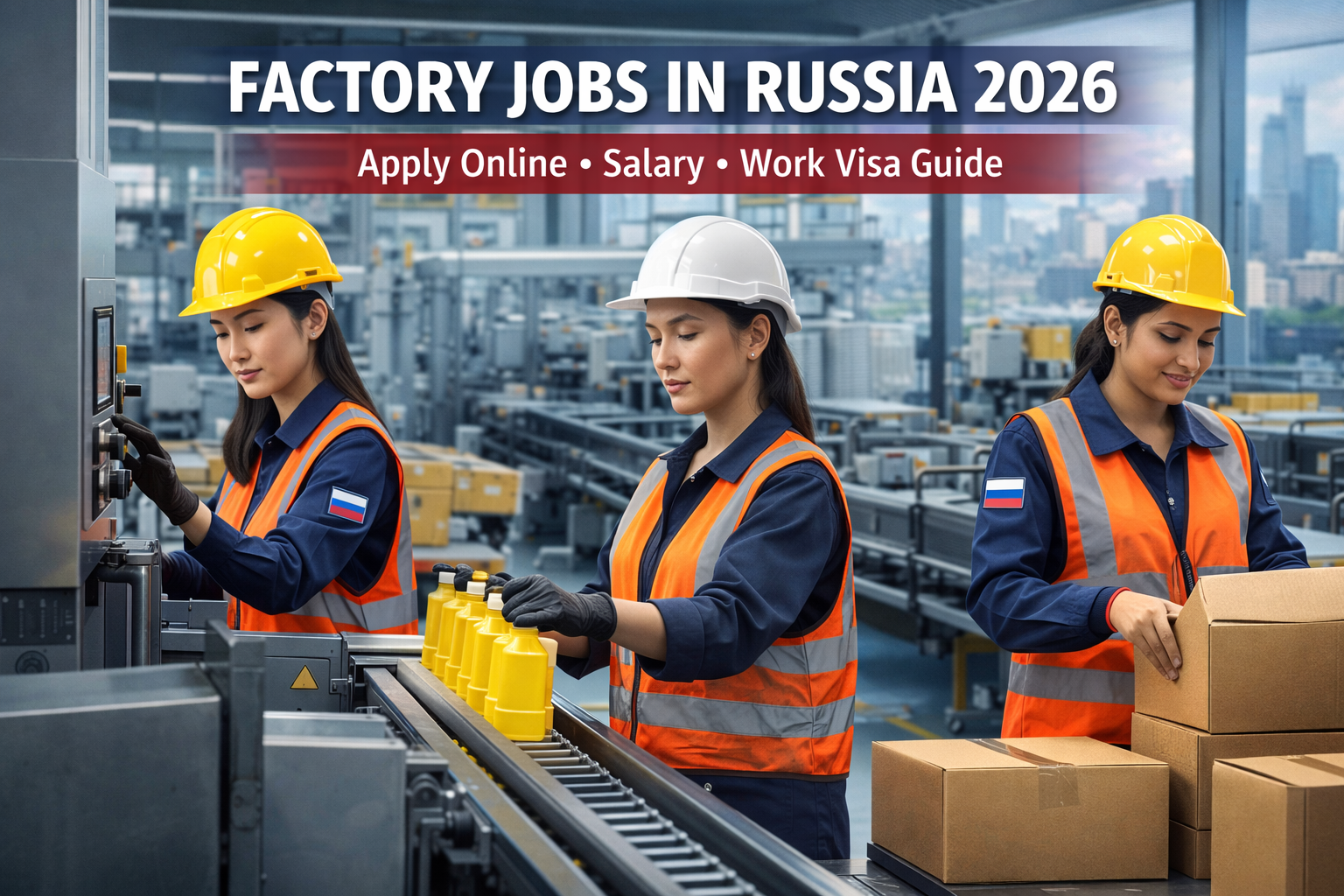
Factory Jobs in Russia 2026 – Apply Online Guide
International working is a trend among individuals seeking improved job opportunities, income and international working experience. A lot of nations in the world employ foreigners in various industries and Russia is among the nations that provide jobs in the manufacturing and industrial sector. Factories in Russia also present a good opportunity to foreign workers seeking a steady job in warehouses, factories, food processing plants, and even industrial production plants.
Russia is also still providing international workers with factory and industrial job opportunities in 2026. These are common employments found in the major cities like Moscow, Saint Petersburg or other industrial areas where manufacturing industries are in need of skilled and semi-skilled labor. The foreigners can be employed in the packaging, machine handling, assembly lines, warehouse operations, and production support areas.
The factory jobs, which are offered in Russia, can be a good choice of the individuals who wish to work in some foreign country, to gain some experience in the sphere of manufacturing industry and to receive stable income. Depending on the job and labor requirements some companies would also assist foreign workers in employment documents and work permits.
This is a comprehensive guide to the requirements, salary, and job description of the Factory Jobs in Russia to Foreigners in 2026, as well as the procedure to apply and work as a visa worker in Russia.
The summary of the factory employment in Russia
- Russia boasts of a large industrial sector which consists of manufacturing sectors, energy production, metal processing, food production, automotive manufacturing, and chemical industries. Due to the scale of operations by these industries, firms tend to have a huge number of employees in order to run production lines and facilitate the operations.
- Russian factory jobs typically work in a manufacturing plant or a production facility where goods are manufactured, assembled, packed or processed. Employees contribute to the effective functioning of the production mechanism and release goods with excellent quality.
- In some cases, foreign workers are employed when the company requires more workers to handle productions. Various factories need the employees who are able to work on machines, control the production lines, pack the finished products, or help with the logistics and the warehouse management.
- The factory jobs can be considered as appropriate to people who can move, can work in industries, and can observe safety measures.
Examples of the Factory Jobs that are in Russia
The Russian manufacturing industry provides the various categories of factory employment based on the industry and manufacturing process.
The job positions in the factory are usually:
- Production line worker
- Machine operator
- Assembly line worker
- Warehouse assistant
- Packaging worker
- Quality control assistant
- Industrial technician
- Food processing worker
- Automotive assembly worker
- Assistant in electronic manufacturing.
The roles could have various duties based on the nature of the factory and production system.
Salary of Factory Workers in Russia
The wages in Russia factory employment rely on a number of variables including the sector, the size of the company, the experience of the worker, and the job description.
The average Russian worker in the factory can make between 40,000 and 90,000 Russian rubles in one month. Certain factory jobs that are specialized or technical usually are better paid.
Examples of approximate monthly salaries are:
- Factory worker: 40,000 – 60,000 RUB
- Machine operator: 50,000 – 80,000 RUB
- Production technician: 60,000 – 90,000 RUB
- Industrial engineer: 80,000 – 120,000 RUB
Other companies can establish other forms of incentives like paying overtime, accommodating employees, or assisting employees traveling in an industrial zone.
The Russian Factories and their Working Conditions
- The factory work is usually one that is carried out in the industrial setting where machines, production equipment and assembly lines are involved. Some of the tasks that workers may do are running machines, assembling, overseeing the production lines, and packaging completed products.
- The majority of factories are scheduled in order to be constantly productive. Different workers can either be assigned morning shifts, evening shifts, or even night shifts based on the demand of production.
- The element of factories as employees is safety regulations. Workers should observe safety practices in the workplace, use protective equipment and use machines with care in order to prevent accidents.
- Teamwork is also a necessity in the factories since the workers need to coordinate their work along the production line in order to ensure efficiency and achieve production goals.
The prerequisites to Factory Jobs in Russia
Foreign workers wishing to work in the factories in Russia are required to pass some requirements. These are necessary so that the employers can monitor the safety and efficiency of workers in their duties.
Ordinary requirements involve:
- Valid passport
- Basic physical fitness
- Capacity to operate in factories.
- Disposition to observe safety measures.
- Basic communication skills
- Past factory/ warehouse experience (preferred occasionally)
There are factory jobs which could demand technical training, or skills to operate machines, particularly in manufacturing sectors which have high equipments.
Russia Work Visa to Foreigners
- Legally, the foreign workers wishing to work in Russia normally require a work visa or work permit issued by the Russian immigration authorities. The work visa enables foreign employees to legally reside and work in the country within a given period of time.
- The employer usually has a significant role in the visa process as the companies are supposed to seek the governments permission before employing foreign workers.
- After receiving the job offer and the required documentation, the worker is allowed to apply to a Russian embassy or a consulate where he/she obtains a work visa.
Documents needed to work in Russia as a visa
When applying to a work visa in Russia, applicants usually require a number of documents.
Common documents include:
- Valid passport
- Contract of employment by employer.
- Work permit approval
- Visa application form
- Passport photographs
- Medical insurance
- Proof of accommodation
Other documents can be provided based on the position of work and immigration laws.
How to apply to work in Russia in the factories step-by-step
There are generally a number of steps to follow in the application of the factory jobs in Russia.
Step 1 – Search for Factory Jobs
On the websites of job portals, recruitment sites or company career pages, job seekers may find factory jobs. The foreign workers are occasionally posted on international job boards and recruitment agencies.
Step 2 – Submit Job Application
The applicants are required to provide professional resume or a CV with supporting documentation in the form of education certificates or work experience details.
Step 3 – Employer Review
Applications are reviewed and interviews may be conducted to screen the candidates by employers. In case the applicant is outside the country where the organization is located, the interview can be carried out online.
Step 4- Job Offer
A choice might lead to a written agreement from the company, spelling out duties, pay, yet terms of work. While picking someone, details get listed – what they’ll do, how much paid, under which conditions.
Step Five– Work Permit Application
A request moves through official channels when a company needs permission for someone to work. Processing begins once paperwork arrives at the immigration office.
Step 6 –Apply for work visa
A permit in hand, the person moves on to seek entry papers at a Russian diplomatic office abroad. Then comes submission – done either at an embassy or one of their consular branches.
Step 7 –Travel and Begin Working
With approval in hand, the worker may head to Russia to start work. Travel becomes possible after the visa clears. Starting the job follows once arrival happens. Only then does employment officially open up.
Benefits of Factory Jobs in Russia
Factory jobs can offer several advantages for workers seeking international employment.
Some benefits include:
- Opportunity to gain international work experience
- Stable income in the manufacturing sector
- Exposure to modern industrial technologies
- Possibility of skill development in technical roles
- Work experience in large manufacturing companies
A path into global manufacturing often begins in factories, where immigrants take their first steps. Workers from abroad find these roles open doors they didn’t expect. Entry-level positions turn into longer journeys through industrial work overseas.
Challenges Foreign Workers May Face
Starting a job at a plant can open doors, yet moving abroad for work brings its own set of hurdles. Though pay and stability might improve, being far from home often means dealing with new rules, languages, or isolation. A paycheck helps, still small things like food, transport, or speaking up can feel harder. Life shifts when routines break, even if the role seems secure on paper. New surroundings sometimes weigh heavier than expected, especially without familiar support nearby.
Common challenges include:
- Language barriers
- Adapting to new workplace environments
- Understanding local labor regulations
- Adjusting to industrial work schedules
Finding your footing on the job often gets easier when firms offer guidance tailored to new hires. Yet some stick close to routine while others shift toward hands-on learning just around midweek.
How to Find Factory Work in Russia
Job seekers can improve their chances of finding factory jobs by following several practical tips.
- Prepare a professional CV with relevant skills
- Apply to multiple companies and recruitment agencies
- Highlight technical or machine operation skills
- Learn basic workplace safety knowledge
- Be open to different production roles
When someone shows up on time, stays focused, plus picks things up quickly, factories tend to choose them more often. People who stick to routines, follow through, yet stay open to feedback usually stand out during hiring. Showing consistency every day matters a lot here. Workers like that fit right into production settings where steady effort counts above all else.
Manufacturing Workforce Shifts in Russia
Factories need people now more than ever. Russia keeps pouring money into building better machines, stronger tech, strong industry setups. With every new plant that opens, demand rises for folks who know how to run heavy gear. More output means more hands are needed on the floor. Workers must keep things moving smoothly day after day.
Out there, people trained in tech fields might land roles where hands-on building matters. Where machines need fixing, those who understand how things move could fit right in. Skills shaped abroad sometimes match what factories here are looking for. Folks used to working with tools often discover openings waiting. Experience gained overseas tends to open doors when it ties to making physical products.
Read more: https://jobs.apktal.com/poland-factory-jobs-2026-apply-guide-for-foreign-workers/
FAQs
-
Foreigners Working in Russian Factories?
Finding a job in Russia is possible for people from other countries – once they get official approval through proper channels. Getting papers ready means applying for both a work visa and permission to be employed, handled by immigration offices. Without these documents in place, starting any kind of employment isn’t allowed under local rules.
-
How much do factory workers earn in Russia?
Month by month, factory hands across Russia pocket sums ranging from 40,000 up to 90,000 rubles, shaped by what they know and the tasks they handle.
-
Do factory jobs in Russia require experience?
Not every factory role expects past work history, yet beginners might get on-the-job learning when starting out.
Getting a job permit for Russia – timing varies. Usually weeks, sometimes longer. Depends on paperwork speed. Embassy workload matters too. Some cases wrap up fast. Others drag past a month. Application type plays role. Processing times shift without notice. Patience helps during wait.
Final Thoughts
Working at factories across Russia during 2026 might suit foreigners looking to enter manufacturing or heavy industry. Experience abroad becomes possible through these roles, while hands-on abilities grow alongside steady paychecks in active plant settings.
Out of Russia’s big industrial base comes a steady need for hands in factories, storage centers, and making things. Depending on who’s hiring and what the work is, rules and paperwork can shift quite a bit. Still, those who fit the role and handle steps the right way might land a position there.
Finding work in Russia’s manufacturing sector often begins with knowing what duties a role requires. Clear paperwork matters just as much as the right skills. Workers from abroad tend to succeed when they use trusted websites to apply. Learning each step carefully helps avoid common mistakes. Success comes more easily when every detail is handled early.
In Short
Not everyone thinks of Russia first, yet factory positions there could suit those keen on hands-on industry tasks by 2026. Work stretches across bustling assembly sites, busy storage hubs, maybe even long-floor production units. A solid job invitation often kicks things off, followed by sorting travel papers one step at a time. Meeting what employers ask – skills, timing, background checks – opens doors without fuss. Big-scale making and building sectors keep expanding, creating space for outsiders ready to jump in.