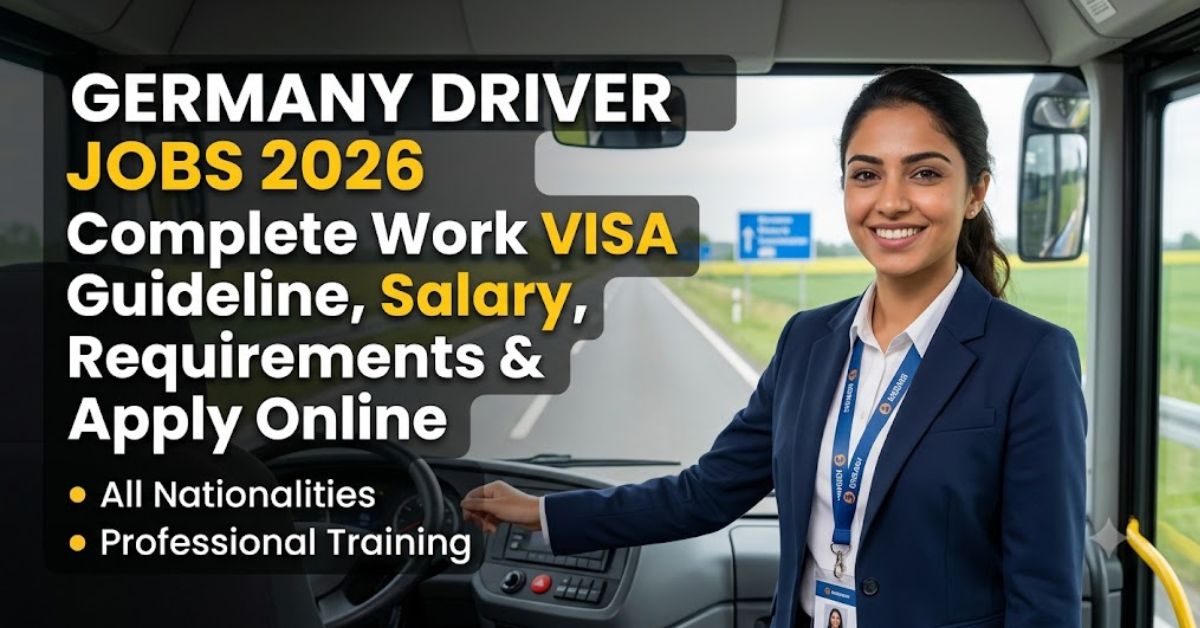
Germany Driver Jobs 2026: Work Visa, Salary & Requirements Guide
Interested in an amazing career in Europe as an experienced driver? The need for professional drivers in Germany is unprecedented and with the year of 2026 fast approaching, the German government and local transport companies are looking worldwide to recruit. There is a considerable shortage of logistics, public transport and long-haul freight drivers, so it’s an excellent moment to learn more about Germany driver jobs.
For those planning to relocate to a new country and find a stable job with a decent salary, it is essential to understand the legal landscape, licensing requirements, and immigration procedures. Recently, Germany updated its Skilled Immigration Act, creating new opportunities such as the Chancenkarte (Opportunity Card) and certain provisions of Section 24a of the Employment Regulation (BeschV) that have made it much simpler for those who are not citizens of the EU to work as truck, bus, and delivery drivers.
Overview: The Driving Job Market in Germany (2026)
Germany is the hub of logistics in Europe. It’s also at the heart of the continent’s supply chain and, as such, relies on a huge fleet of commercial vehicles for cross-border and domestic deliveries. Even in 2026, qualified professional drivers (from heavy goods vehicle operators to municipal bus drivers) are one of the biggest challenges for the German economy.
In response, German transport and logistics businesses are now looking outside the EU and EEA to recruit the necessary drivers, with the help of new policies. The German Federal Employment Agency (Bundesagentur für Arbeit) is actively seeking approval for foreign drivers, because the domestic market is no longer being able to keep up with the demand.
This means job security, attractive salaries, and an accepting regulatory climate for international job seekers. It may be heading through the thick logistics system of Nordrhein-Westfalen (NRW), transporting automotive components through Bavaria or operating international routes from the Frankfurt airfreight hubs, the possibilities are endless. Employers are not merely providing employment, but also career stability and all the German way of social security packages.
Types of Driver Jobs Available
In the field of jobs in Germany, it is crucial to recognize that there are different types of transportation. Driving style, routes driven, and type of vehicle will greatly affect lifestyle, home time and earning potential. Here are some of the main driving positions expected in Germany for 2026:
Long haul truck drivers (Fernverkehr)
The backbone of European trade are long haul drivers. In this position you will be tasked to deliver freight over large distances, either within Germany or over the borders of Europe. This position frequently involves driving away from home for several nights or weeks and sleeping in the cab of the truck. Due to the rigorous driving schedule, long-haul drivers have some of the highest pay rates in the industry, and are entitled to daily allowances (Spesen) that are paid tax-free.
Regional and local distribution (Nahverkehr)
Regional distribution is the best option if you want to be home every night and have a more predictable schedule. In this classification, goods are transported in the city or region where the company is based, for instance to supermarkets or construction sites, or regional warehouses. The salary for such lines may be a little lower than for long haul lines, but the time off for home may be a lot better, with daily home time.
Public Transport and Bus Drivers
There is a high demand for qualified bus drivers in German cities, which have some of the best public transport systems in the world. Hiring of inner city buses (Linienbusse) and long-distance coaches (Reisebusse) is a common practice by municipalities and private transport companies. Must possess a valid Class D/DE license, have excellent customer service skills, and be of a calm demeanor in the event of heavy traffic.
Specialized Transport (Dangerous Goods / ADR & Tankers)
People who drive vehicles carrying hazardous materials (Gefahrgut) and/or liquids (Tankwagen) need to be trained and certified, and have an ADR license. Drivers working in this sector will be well paid, sometimes with premium pay, because of the high level of responsibility, risk and technical skill.
Detailed Salary Guide: How Much Do You Make?
Germany offers financial stability as one of the advantages of living in Germany as a professional driver. Germany’s salary system is well regulated and is frequently determined through collective bargaining agreements (Tarifverträge), ensuring fair pay.
Average Monthly Base Salaries (Gross)
The base salary for drivers varies by region in Germany and the type of work they do, as of 2026.
- Local / Regional Delivery: €2,400 – €3,000 per month
- Long-Haul (National): €3,200 – €3,800 per month
- International Routes: €3,500 – €4,200+ per month
- Specialized / ADR Transport: €3,800 – €4,600+ per month
Allowances and Bonuses (Zuschläge)
The tax-free allowance period and the legally required bonuses greatly enhance a driver’s take-home pay in Germany:
- Per-Diem Allowance (Spesen): If drivers drive on long-haul trips, they receive an allowance for food and expenses that is not taxable, per day. It is standard practice to charge €14 for half a day away and €28 for a full day, so it’s worth hundreds of euros per month.
- The night shift premium (Nachtzuschlag) is typically 20% to 25% more per hour for people who work at night.
- Overnight driving (Sunday and Holiday Pay) may include between 50% to 125% premium.
- Many employers will give 13th month salary or split bonuses given in the summer holiday and before Christmas.
It should be noted that the minimum gross income for the employment visa at the age of over 45 is €55,770 per year (in 2026) or an appropriate pension plan. To make sure you are not reliant on the state pension system at retirement age.
Crucial Requirements & Qualifications
The profession of a professional driver in Germany is highly regulated. Just getting a car’s license is not sufficient to start driving commercial trucks. In order to be eligible for a visa and employment, you’ll need to meet strict legal and professional requirements.
The Correct Driving License
Must have a current valid driving licence suitable for the type of vehicle being driven. This applies to trucks and heavy goods vehicles and is a Class C, CE, C1 or C1E license. A class D, DE, D1 or D1E license is required for passenger transport (buses). If your licence was issued outside the EU/EEA you will probably have to go through a process of recognition or partial retraining to obtain an EU compliant licence, which is a requirement for commercial driving in Germany.
Professional Driver Qualification (Module 95 / Code 95)
Heavy vehicle licence is not sufficient. European Union legislation requires all commercial lorry, bus, coach and van drivers to hold the Basic Professional Driver Qualification or Code 95.
If you have gained this qualification in an EU/EEA country, this will normally be recognised straight away.
This is frequently the main challenge for those of you from outside the EU. To have the Code 95 added to your EU driver’s license or to get a Driver Qualification Certificate you need to pass a theoretical and practical exam in Germany, which requires knowledge of the German language.
Digital Tachograph Card (Fahrerkarte)
All commercial drivers flying vehicles over 3.5 ton in Europe are required to have a personal digital tachograph card. To ensure adherence to very strict EU driving times and breaks, this smart card logs your driving, breaks and rest periods. After you’ve lived in Germany for a while, you can apply for this card.
Language Skills
Some business communication in English and a certain knowledge of German will be sufficient for international long haul transport, but in regional delivery (Nahverkehr) and bus driving good German language skills are essential. Must be able to read and understand road signs, communicate with dispatchers, understand shipping documents and communicate with customers/passengers. With the B1 level in German, you will have a significantly better employability and everyday life.
Work Visa Pathways for Professional Drivers
Germany has changed its immigration policies to draw in more highly trained personnel. There are several different visa options that you can take up to make a move to Germany as a professional driver in 2026.
Professional Driver Visa (Section 24a BeschV)
The quickest way for drivers from outside the EU is to obtain a visa with a special purpose for the job, as outlined in Section 24a of the Ordinance on the Employment of Foreigners (BeschV).
This particular work visa requires you to have:
- A job offer letter in German signed by a transport company.
- EU/EEA issued class C, CE, D or DE driving license.
- Basic qualification of the EU (Code 95).
Some employers may also provide a contract with the completion of this qualification in Germany, provided this training has been approved in advance by the Federal Employment Agency – if you do not yet have the EU Code 95 qualification.
The Opportunity Card (Chancenkarte)
The Chancenkarte has been introduced under the auspices of the Skilled Immigration Act and is a game-changer. It enables individuals from non-EU nations to enter Germany to find a position for up to 12 months before they have a job lined up.
How the Chancenkarte works:
Full recognition of foreign qualifications (e.g. a professional driving license) in Germany: Automatic eligibility.
If your qualifications are not fully recognized, you can qualify with a minimum of 6 points based on your professional experience, your age (under 35 gives more points), your language abilities (German A1 or English B2 at least) and your connection to Germany.
Financial Proof: This will require proof that you can support yourself during the job search; proof of funds of €1,091/month (for 12 months) is normally kept in a German Blocked Account (Sperrkonto).
During the Opportunity Card phase, you can work part-time (20 hours per week or less) to get experience and earn money in the community and finish training for your driver qualification and get a full-time contract.
Step-by-Step Application Process
Planning is important when relocating your life and career to Germany. This guide will help you get through the transition with ease.
Step 1: Prepare Your Documentation
Collect all necessary paperwork. This includes your passport, current driving license, driving experience proof (in the form of reference letters), clean criminal record (Führungszeugnis) and German-style CV in a professional format (Lebenslauf).
Step 2: License and Qualification Check
Check where your licence is in terms of its condition. If you live outside the EU, find out what is needed to transfer your license to a German/EU license and how you will get the qualification Code 95. Some forward-thinking German employers will cover the expenses and accompany you through the tedious paperwork at the time, but it is important to know the rules beforehand.
Step 3: obtain a Job Offer (or apply for Chancenkarte)
Apply for positions directly through job portals such as StepStone, LinkedIn, Job Messenger from the Federal Employment Agency (BA) or specific logistics recruitment sites. The standard work visa can be secured only after obtaining a confirmed job offer.
Apply at your local German embassy for the Chancenkarte to be granted if you fit the criteria and have the required savings (€13,092 in a blocked account) for them to approve your application for you to move to Germany first, then look for jobs there.
Step 4: Apply for the Visa
Arrange an appointment with the German embassy or consulate in your birth country, with the contract (or the blocked account). You will need to submit your application form, biometric photos, employment declaration (Erklärung zum Beschäftigungsverhältnis) filled out by your employer, and proof of health insurance.
Step 5: Relocation and Registration
Your national visa will be valid for you automatically as soon as you arrive in Germany, you have to register your address at the Bürgeramt (citizens’ office) in your city or state of residence as soon as you arrive. You will also have to arrange your German health insurance and open a bank account in Germany. Last but not least, you need to get your entry visa converted to a formal residence permit (Aufenthaltstitel) by the Foreigners’ Authority (Ausländerbehörde).
Key Benefits of Working as a Driver in Germany
There’s more to being employed in Germany than just a paycheck, and more to an excellent lifestyle than a high salary, of course.
Comprehensive Social Security
When you are employed in Germany, you are automatically integrated into one of the world’s best social security systems. Each month, you make contributions to the mandatory health insurance (Krankenversicherung), pension insurance (Rentenversicherung), unemployment insurance (Arbeitslosenversicherung) and long-term care insurance. You are still paid for up to 6 weeks if you fall ill, and your medical expenses are covered.
Strict Labor Laws and Safety
Driving and rest time regulations are strict in the EU. With digital tachographs, companies can no longer get drivers to drive recklessly longer hours. This will ensure you’ll get proper rest, which will keep you healthy and safe on the road. In addition, many transport companies provide 27-30 days of vacation, while German labor laws require a minimum of 20-24 days of vacation per year.
Family Reunification
With a valid residence permit and a stable income and apartment, those who are established in Germany may be able to invite their spouse and minor children to Germany. Also your spouse will have unrestricted access to the German labour market.
Pathway to Permanent Residency
Germany has obvious paths leading to a permanent settlement. After five years of permanent residence and if you have a standard work visa, you can apply for a permanent settlement permit (Niederlassungserlaubnis), as long as you reach B1 level in German.
Expert Tips for a Successful Application
When it comes to the competitive German job market, here are some steps in the right direction from experts:
- Learn German Now: Do not wait until you have reached. Learn German now. Large international logistics companies may hire employees who speak English, however, even if you have an A2 level of German, it proves commitment and can open up a wide range of job opportunities, particularly with local routes.
- Adapt Your CV: German employers have a particular format for CVs. It should be professional, factual and have a professional photograph in it. Describe your driving experience, including the types of vehicles you have driven, and any mechanical skills you have.
- Know the Geography: Know the main logistics centres in Germany (e.g. NRW Ruhr, Frankfurt airport, industrial areas of Bavaria and Baden-Württemberg). When you are looking to find a job, you will find it quicker to look at jobs in these areas.
Common Mistakes to Avoid
It’s not easy to get into Canada and find a driving job. Steer clear of these common mistakes:
- Ignoring the Code 95 Requirement;heavy vehicle license issued by a non-EU country will do the job. Time and expenses need to be considered for obtaining the EU professional driver qualification (Code 95).
- Using Unscrupulous Recruitment Agencies: Be careful of recruitment agencies that offer “guaranteed visas”, or those that ask you to pay a large sum of money up front to secure a placement. A good employer or a recognized headhunter will usually be remunerated by the company and not the applicant.
- Underestimating the Cost of Living: Salaries are good, but the Cost of Living, especially in big cities such as Munich or Frankfurt, can be high. Before signing a contract, make sure to work out your net income (after taxes and social contributions) and plan accordingly.
- Filling out the Wrong Visa: If you’re applying as a professional driver, make sure your employer is filling out the Declaration of Employment correctly, based on the requirements in the section 24a. Errors in this can result in lengthy delays or visa denial.
FAQs
-
How to get a driving license in Germany from a foreign one (without EU driving license)?
This will vary by country where your driving license is issued. Certain countries have reciprocal agreements with Germany and a direct exchange is possible. In most other countries outside of the EU, however, you will have to pass a theoretical and practical driving test in Germany to get your license to drive a heavy vehicle.
-
What is the age limit to apply for a car driver job in Germany?
There’s not a definite age limit for driving. If you’re aged 45 or above and applying for a work visa, however, the German government demands a minimum gross income of €55,770 per year (2026) or that you are in possession of adequate pension benefits.
-
Do I have to speak German to get a truck driving job?
English is acceptable for long-haul and international flights. For local delivery, bus driving and everyday use of the German language, however, at least conversational German (A2/B1 level) is strongly recommended, and sometimes required, for local delivery, bus driving and everyday life in Germany.
-
Is the Opportunity Card (Chancenkarte) better than a direct work visa?
The Chancenkarte is excellent if you have funds (€13,092) and want to attend interviews in person in Germany. However, if you can secure a job offer from abroad, the direct work visa provides immediate full-time employment and financial stability upon arrival.
Final Thoughts
Securing a driver job in Germany in 2026 is an excellent career move for skilled professionals seeking stability, high wages, and a high standard of living. With the ongoing driver shortage, the German government and logistics sector have opened the doors wider than ever through streamlined visa processes like Section 24a and the innovative Opportunity Card (Chancenkarte).
While the bureaucratic requirements—such as license conversion and obtaining the EU Code 95 qualification—require patience and diligence, the long-term rewards are undeniable. By understanding the legal requirements, preparing your documents meticulously, and choosing the right visa pathway, you can successfully navigate the process. Start learning German, update your CV, and take the first step toward a rewarding professional driving career in the heart of Europe.